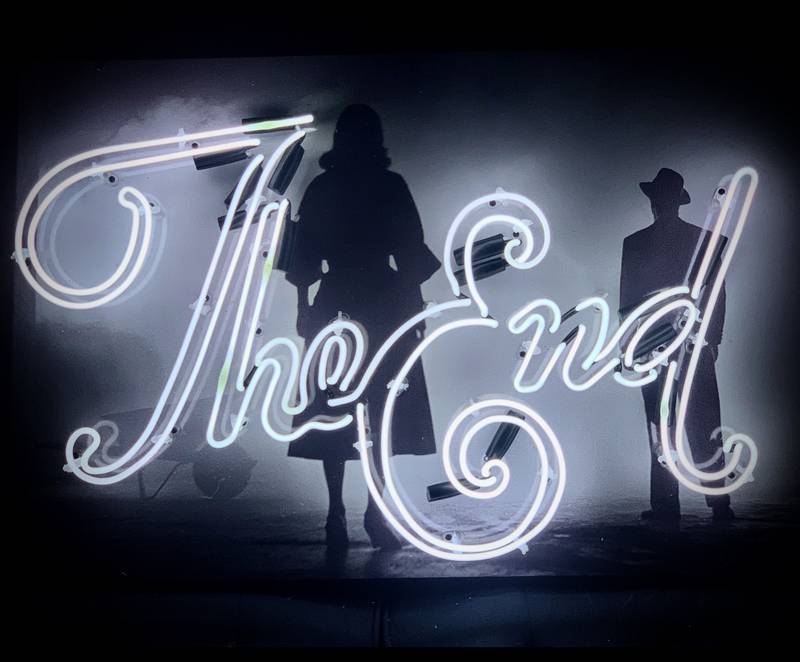
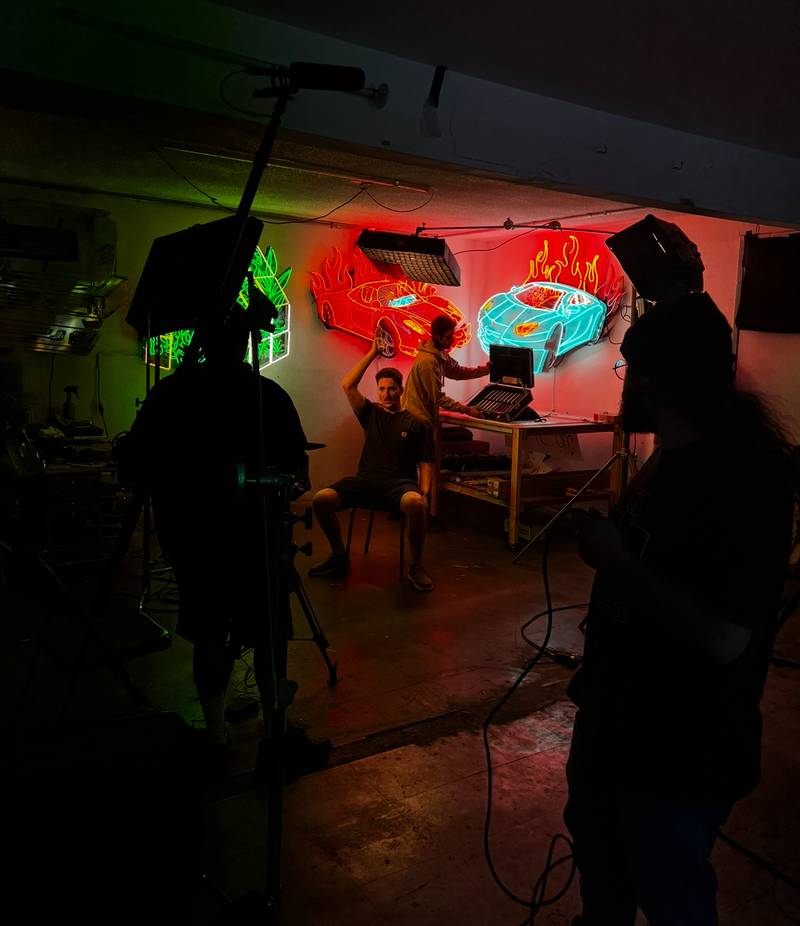
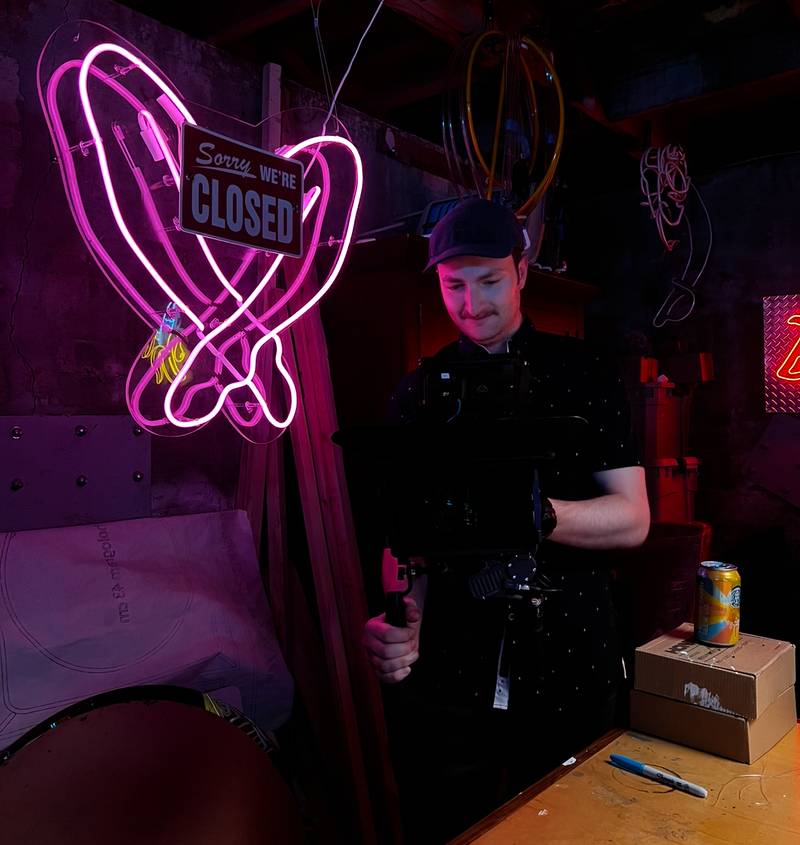
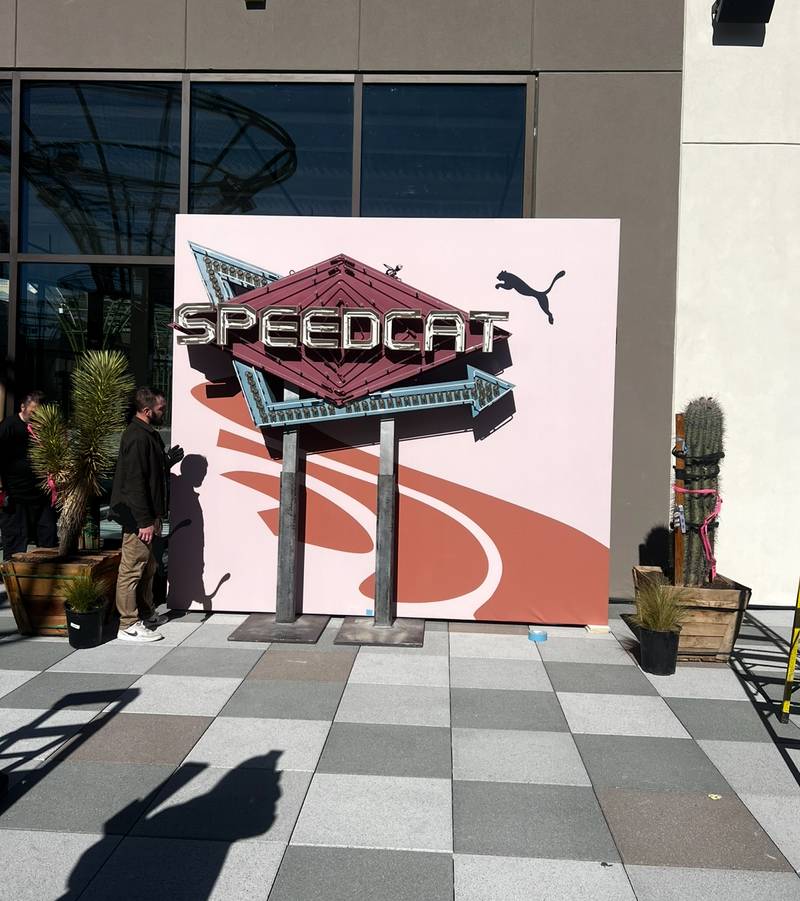
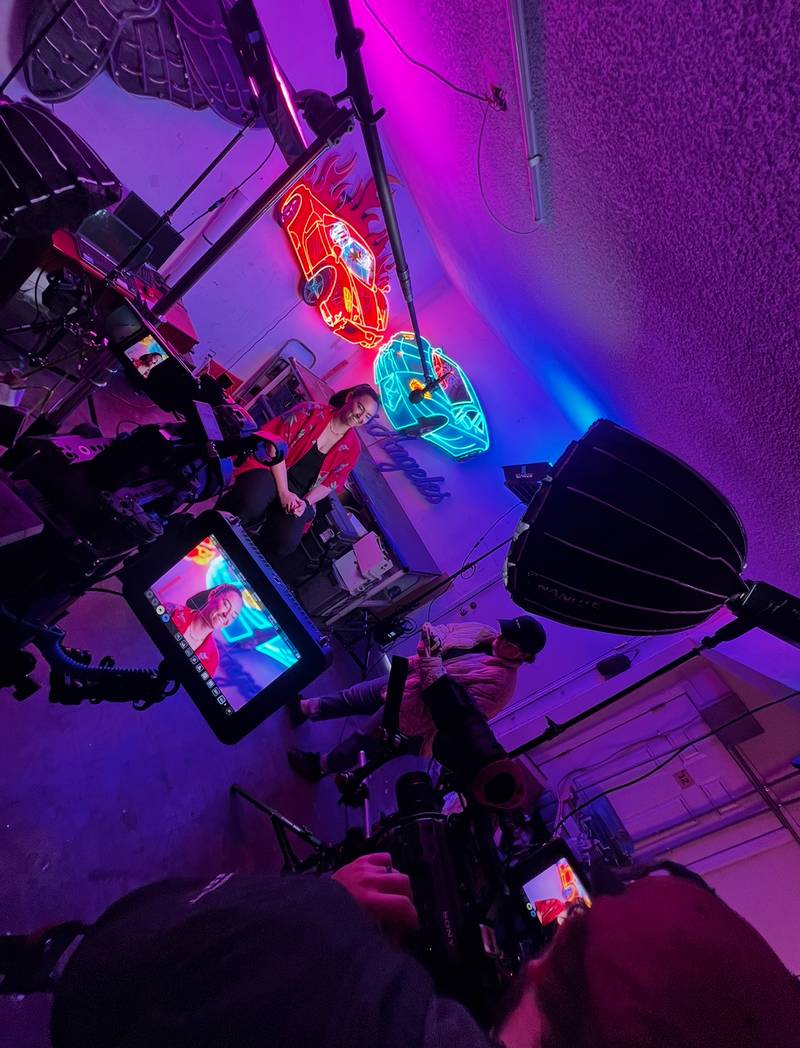
Practical neon still reads on camera in a way a printed sign never will. The glow's real. The depth's real. The warmth radiating off a live transformer is real — and a camera picks all of that up in a way a backlit vinyl flat or an LED panel pretending to be neon just can't. I'm Dani Bonnet, and at Neon Flamingo I build neon for film and TV production in Los Angeles — features, series, commercials, music videos, stills shoots. I also rent from existing inventory when a full build isn't worth it for two days of shooting. Productions I've worked with include Netflix and the Jimmy Kimmel Vegas Vic restoration, so if you need a fabricator who actually understands what "picture-ready" means, keep reading.
This isn't a sign shop that occasionally takes a production call. The Echo Park studio is set up for it — rush builds, camera-safe transformers, rigging documentation, delivery and install to stage or location, strike after wrap. All of it.
Custom neon props and set signage
What gets built for productions is a wider range than most art departments expect going in. Bar signs, motel and diner signage, storefront hero signs, window practicals, hallway background pieces, and hero props built specifically for close-ups, where every detail of the tube work is going to be visible under a long lens. Every piece gets specified from scratch for the scene it's going into — nothing gets pulled off a shelf and hoped into place.
What separates a neon prop that works from one that doesn't is the detail that goes into the spec. Letterform, tube diameter, and color temperature are the three things that tell a viewer — consciously or not — what decade they're looking at. Thick tube diameters (15–18mm) in warm white and cherry red, set in heavy block letterforms on a porcelain housing, read 1940s–50s. Thinner tubes, more color variety, early script letterforms start pushing into the 1960s–70s. The saturated argon-mercury blues and greens of the 1980s — brighter, more electric, used as aesthetic rather than pure signage — is a completely different spec. Get any of that wrong and the sign pulls focus for the wrong reason.
Aged and weathered finishes get built in at fabrication, not added in post. That's deliberate phosphor degradation inside the tube for a dimmer, yellowed glow, darkened electrode ends that show wear, housings finished to read decades old. Flicker and failing-tube effects get fabricated too, not faked — a sign that flickers convincingly on camera needs the right transformer behavior, not a VFX pass. This is the level of detail an art department on a period piece actually cares about, and it's the level I work to on every set-dressing job.
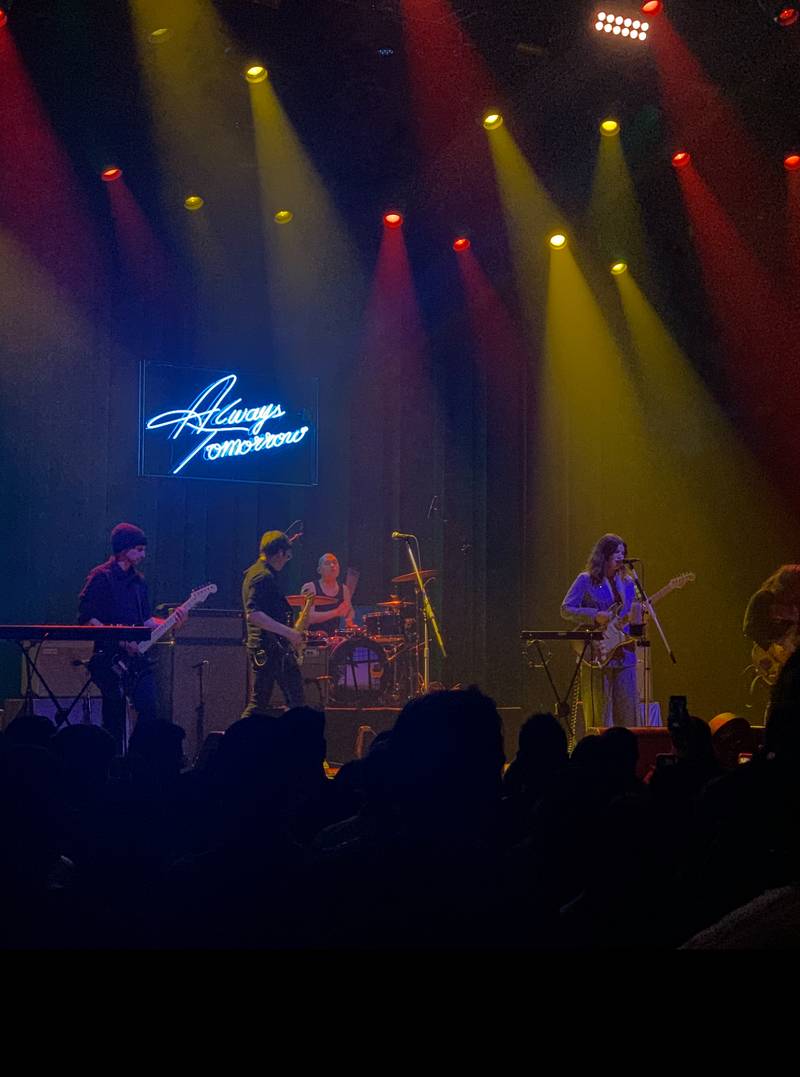
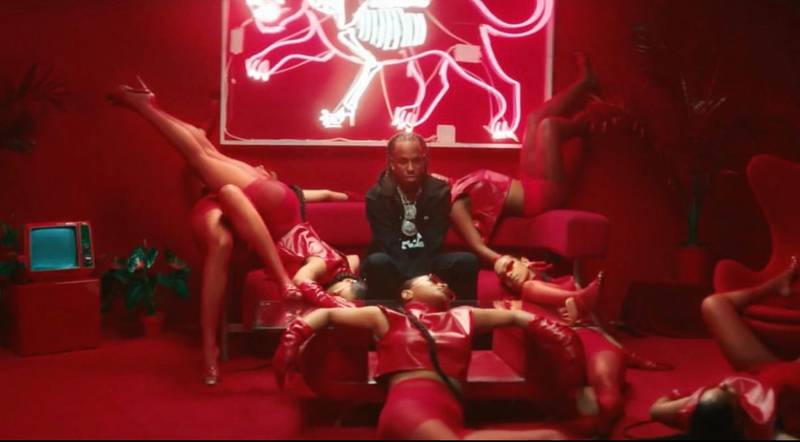
Commercial and music video work often runs the opposite direction — clean, contemporary, high-saturation — but the same rule applies: every part of the sign gets specified to what the camera needs to see, not just what looks good standing in the room.
Neon sign rentals for film and TV
Renting is often the smarter move. If you need a practical sign for two or three shoot days and the wording isn't show-specific, there's no reason to commission a build. My inventory is an eclectic mix of glass and LED pieces built for my own shows and commissions over the years, which means it reads as mood lighting and set dressing rather than off-the-shelf phrase signs. I don't stock "Good Vibes Only." What's there is a working collection of real fabricated pieces with actual character.
Briefing a rental is simple: send me the look, the palette, the scene. I'll tell you what's actually available that fits. No overpromising on pieces that don't exist.
A rental quote covers everything in one line — the sign, transport, delivery to stage or location, safe install, strike and collection after wrap. No separate logistics invoice to untangle later. If the wording is show-specific — a bar name, a fictional brand, something that needs to recur across episodes — a build is usually the better call, and it can be quoted on a production timeline. Productions move fast, and this process is built to match that.
Rush builds on a shoot date
Tell me the shoot date at first contact. Not after the art department's locked the look. Not after the location scout confirms the stage. At first contact.
Standard fabrication runs two to four weeks from approved artwork — that covers the design approval window, the bending queue, aging and testing, and transport. A rush build is possible depending on complexity and shop load, but it means compressing every one of those stages. The approval window gets shorter, which means the art department has to move fast on sign-offs. The job jumps the bending queue, which affects other work in the studio. The aging and testing phase — where a sign runs for extended hours to stabilize the gas and confirm the transformer's behaving — gets shortened, and that's a real risk. A sign that hasn't been properly run in can act unpredictably on set.
Some dates just aren't realistic, and I'll say so immediately instead of missing them later. That's the actual differentiator. Production people have been burned before by suppliers who take the job, go quiet, and then deliver late or not at all. Fast turnaround on a deadline only works if I'm honest about what's actually achievable — a studio willing to tell you no when no is the right answer is more useful to your production than one that says yes to everything and figures it out later.
If you're up against a deadline, the earlier you call, the more options you've got.
Working with the art department
My job here is to make the art department's job easier, not add to it. Here's what's standard on any production job:
Rigging and safety documentation. Load ratings, mounting hardware specs, electrical safety certification — everything the production's safety coordinator needs, supplied ahead of time.
Hidden power runs and cable management to set. A sign that reads beautifully on camera but has a visible cable run across the floor isn't finished. Power routing is part of the build spec, not something figured out on the day.
Dimmable, camera-safe transformers, specified to avoid flicker banding at the production's frame rate. Flicker banding happens when a light source's AC cycle doesn't line up with the camera's shutter speed and sensor readout — you get dark bands rolling through frame, especially with rolling shutter sensors. At 24fps with a 180-degree shutter, the exposure window is roughly 1/48 of a second; at 30fps it's 1/60; at 60fps it's 1/120. The transformer frequency needs to match those windows to keep it clean. I spec this at the build stage, so it's not something anyone's solving on the day.
On-set support for installs and adjustments while shooting.If a sign needs repositioning between setups, or a tube needs attention mid-shoot, I can be there.
Condition notes for rental returns. Clear documentation of the sign's condition at delivery and at collection, so there's nothing to dispute at wrap.
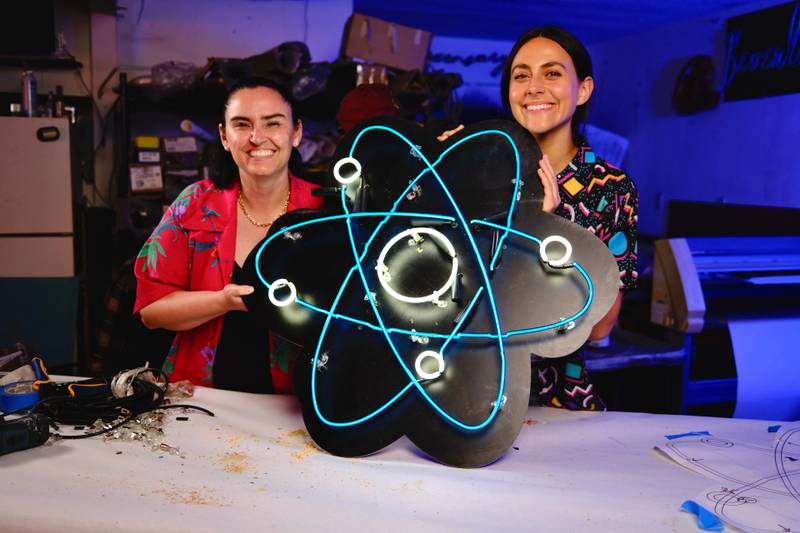
Recent production work includes a hybrid neon and LED hologram installation for Netflix's Sunset Boulevard office, and the restoration of Jimmy Kimmel's 20-foot Vegas Vic neon replica — a project that needed period-accurate fabrication, structural engineering for the scale, and close coordination with the production team on install. Both jobs needed a fabricator who understands the difference between a sign that looks good standing in front of it and one that actually reads correctly on camera: color temperature, glow radius, tube diameter matched to the lens being used.
Period-correct neon — making a sign read as a specific decade
This is the question prop masters and set decorators ask me more than anything else, and it deserves a real answer.
Every part of a sign contributes to what decade it reads as — not just the letterform, but tube diameter, gas mix, transformer type, housing material, mounting style. Get all of it right and the sign disappears into the period. Get one thing wrong and it pulls focus.
1940s–50s. Thick tube diameters — usually 15–18mm — in warm white (pure neon gas) and cherry red. Block letterforms, often with a hand-lettered quality that reflects the craft of the period. Heavy porcelain or painted steel housings, surface-mounted on brick or timber. Transformers are big, heavy, and audible. The whole effect is warm, dense, and slightly imprecise — which is exactly right for the period.
1960s–70s. Tube diameters thin out (12–15mm). More color enters the palette — greens, blues, pinks become common as gas mixing gets better. Script letterforms show up everywhere, especially on restaurant and motel signage. Housings get lighter and more standardized. Still warm, but more varied and a bit more polished than the decade before.
1980s. This is where neon turns aesthetic instead of purely functional. Argon-mercury tubes produce the saturated electric blues and greens that define the decade's whole visual language. Thinner tubes, cleaner lines, more geometric forms. Neon becomes decoration — in shop windows, in bars, in the background of every music video — instead of just commercial signage. The transformer choice shifts too: smaller, quieter, more precise.
Contemporary. Clean lines, a minimal palette, often one color on a minimal backing. Interestingly, a lot of what passes as neon on contemporary sets is actually LED flex, and for background pieces at a distance, it can work fine. It rarely holds up as a practical sign under a close lens, though — the glow radius is wrong, the color temperature's flatter, the tube profile reads differently. For a hero prop in the foreground, glass is still the only real answer.
The Neon Museum's history of neon sign evolution is a good reference if you want to go deeper on the historical context.
Frequently asked questions
Do you rent neon signs to film and TV productions?
Yes — and that's exactly what the inventory's for. It's an eclectic, one-of-a-kind mix of glass and LED pieces built for my own shows and commissions, so it reads as mood lighting and set dressing rather than off-the-shelf wording. I don't stock generic phrase signs. Tell me the look, the palette, and the scene, and I'll tell you what's actually available. One quote covers the sign, transport, delivery to stage or location, safe install, and strike and collection after wrap.
Can you build a neon prop on a production timeline?
Yes, depending on complexity and shop load, and the earlier you tell me the shoot date, the more options you have. Rush fabrication is possible, but it comes with real trade-offs at every stage. Tell me the date at first contact, not after the look's locked. If a date isn't realistic, I'll say so right away instead of missing it.
Can a neon sign be made to look period-correct?
Yes. Letterform, tube diameter, color temperature, housing material, and mounting style all signal the decade a sign reads as. I build to a specified period, including aged and weathered finishes — deliberate phosphor degradation, darkened electrode ends, period-appropriate housings — and can build in deliberate flicker or failing-tube effects at fabrication.
Can practical neon be dimmed or made to flicker on camera?
Yes. Dimmable transformers are standard on production builds. Flicker and failing-tube effects get built in at fabrication, not added in post. I also spec transformers to avoid flicker banding at the production's frame rate — 24fps, 30fps, and 60fps each need different transformer frequency matching to keep the image clean. That's handled at the build stage so it's not a problem on set.
Do you deliver and install to set?
Yes — delivery and install across Los Angeles to stages and location shoots. Rigging and safety documentation goes to the art department ahead of time. On-set support is available for installs and adjustments during shooting. Strike and collection after wrap is included in the rental quote.
What's the difference between glass neon and LED neon on camera?
Glass has a natural glow radius, warmth in the color temperature, and a tube profile that reads differently under a lens than LED flex does. For background pieces at a distance, LED can work fine, and it's lighter and easier to travel with. But for a hero prop in the foreground under a close lens, glass is the only real answer — the glow radius on LED flex is too flat, the color temperature's cooler, and the tube profile doesn't hold up to scrutiny. Productions that have tried passing LED flex as a hero prop in close-up have generally regretted it.
See how signs get made on the custom neon sign fabricationpage, browse recent projects, or check out artistic neon and neon art. Working on a shoot? Get in touch.
This page was written by Dani Bonnet, founder and lead fabricator at Neon Flamingo, supplying practical neon to film and TV productions in Los Angeles, including work for Netflix and major commercial productions.