How I Create a Custom Neon Sign, Start to Finish
People ask me all the time what actually goes into building a custom neon sign — how much of it is really "custom," and what the process looks like between someone's idea and a finished piece glowing on their wall. I want to walk through it honestly, the way I actually build every sign in my Los Angeles studio, from a small personal piece to a large commercial installation.
There are six stages to every neon sign I make: concept, design, glass bending, gas filling, wiring, and assembly. Here's what happens at each one.
1. Concept
Every project starts with a conversation. Sometimes a client comes to me with a fully formed idea — a logo, a phrase, a piece of handwriting they want recreated. Other times it's much looser: a vibe, a color palette, a rough size, and they want my help shaping it into something concrete. Either way, my job at this stage is to understand not just what the sign should say or look like, but where it's going to live — a storefront window, a living room wall, a film set — because that changes almost everything about how I approach the design.
2. Design
Once I understand the concept, I move into an actual design: a to-scale drawing that shows exact dimensions, exact colors, and the precise path the neon tubing will take. This is the stage where customization really lives. I'll adjust letterforms so they bend cleanly in glass, resize elements so the proportions read correctly at the sign's actual scale, and confirm color choices against real glass samples — not just a screen. Nothing goes to fabrication until the design is approved, because changes get much harder (and more expensive) once glass is involved.
3. Glass Bending
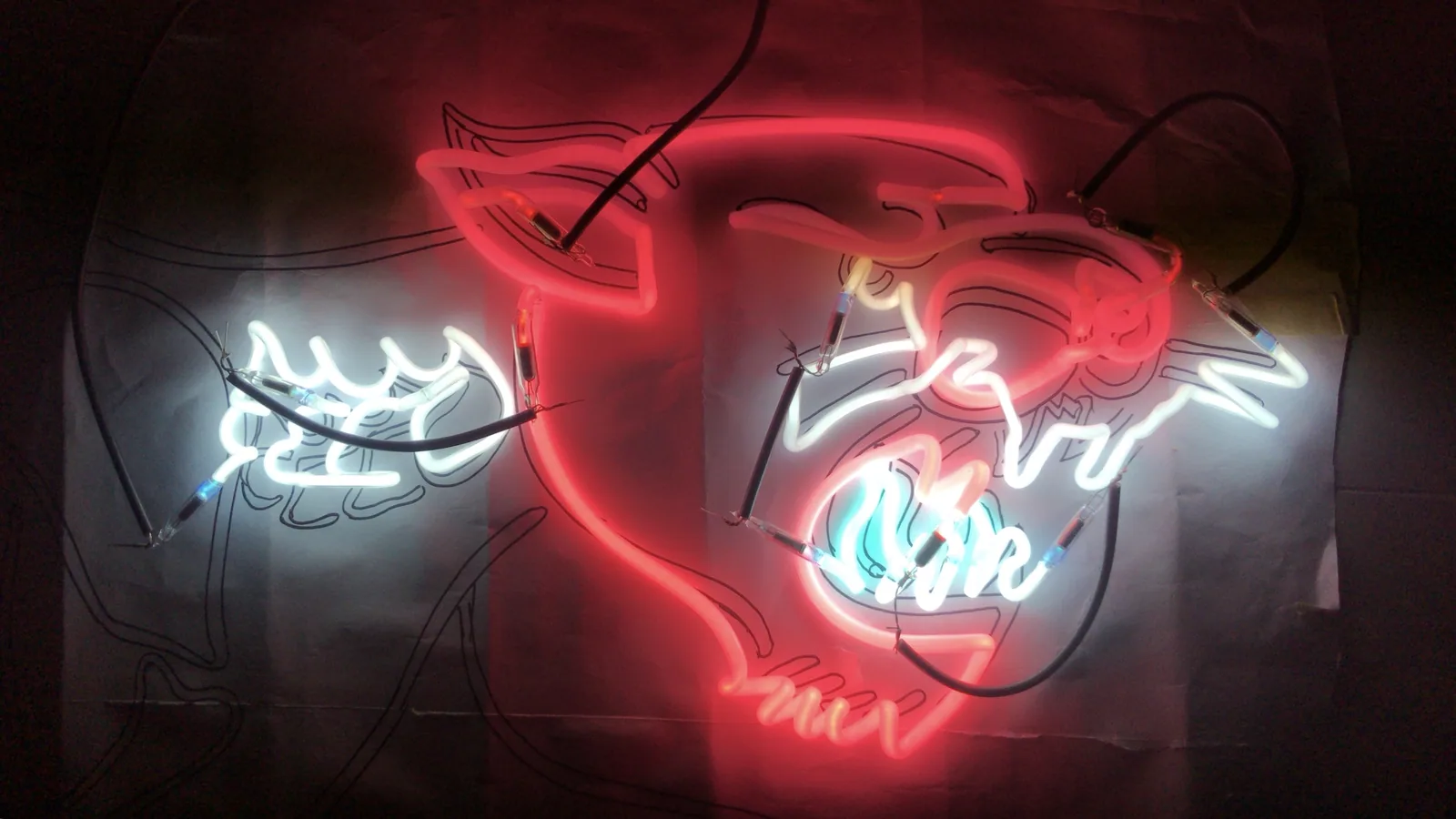
This is the part most people picture when they think of neon, and it's the most technically demanding stage. I heat glass tubing over an open flame until it's pliable, then hand-bend it to match the approved design, section by section. Every curve, every letter, every angle is shaped entirely by hand — there's no mold, no machine doing this part. A single sign can take anywhere from a few hours to several days of glass work depending on complexity, and it's a skill that takes years to do reliably at a professional level.
4. Gas Filling
Once the glass is bent into its final shape, I fill each tube with gas — neon gas for warm reds and oranges, or argon (sometimes with a touch of mercury) for blues, greens, and most other colors. The gas is what actually lights up when electricity runs through it; the color you see comes from a combination of the gas type and the coating on the inside of the glass tube. This step has to be done precisely — the wrong pressure or a leak in the seal means the sign won't hold its glow.
5. Wiring
With the glass filled and sealed, I wire the piece to a transformer, which steps up standard electrical current to the high voltage neon needs to glow. For anything commercial or anything installed permanently, this stage also means routing wiring cleanly and safely — especially for larger installations, where wiring often needs to be concealed and up to code.
6. Assembly
The final stage is putting everything together: mounting the glass to its backing (acrylic, wood, metal, or directly to a wall, depending on the piece), securing the transformer, and doing a full test to make sure every section lights evenly and correctly. Once it passes that final check, it's ready to ship, deliver, or install.
Where Customization Actually Happens
People sometimes assume "custom neon sign" just means picking a color and a font from a template. In my studio, it means something closer to what I described above: a design built specifically for your space, your wording, your exact color palette, and your sizing — not a pre-made shape with your name swapped in. That's true whether I'm building a small piece for someone's apartment or a large-scale commercial installation.
It's a slower process than ordering something off the shelf, but it's the only way to get a sign that's actually built for what you had in mind — not just close to it.
Have an idea you want to turn into a custom neon sign? Tell me about your project and I'll walk you through what it would take to build.
Everything described here happens in our Los Angeles shop as part of our custom neon sign fabrication service — hand-drawn patterns, hand-bent glass, tested and shipped from LA.