How does an infinity mirror work?
There isn't a screen hiding in there, and it isn't a hologram. An infinity mirror is an optical effect made with two reflective surfaces and a light source between them. At the back is a mirror. At the front is a partially reflective mirror, sometimes called a two-way mirror, that reflects some light back into the frame while letting some pass through to you.
The light bounces between those surfaces. Each time you see it through the front, you're seeing another reflection of the same physical sign. Those reflections line up behind one another, creating the appearance of a tunnel much deeper than the actual housing. A relatively shallow object can look like it has a whole other room inside it.
It isn't literally infinite: each reflection loses some light, so the copies get dimmer as they recede. That fading is part of what makes the illusion convincing. Mirror spacing, the position of the lettering, reflectivity and alignment all change the result. Keeping the surfaces parallel gives a more centered tunnel; changing their relationship can send the repetitions off in another direction. I work those things out as part of the design, not as an afterthought.
A brand activation with something a little strange in it
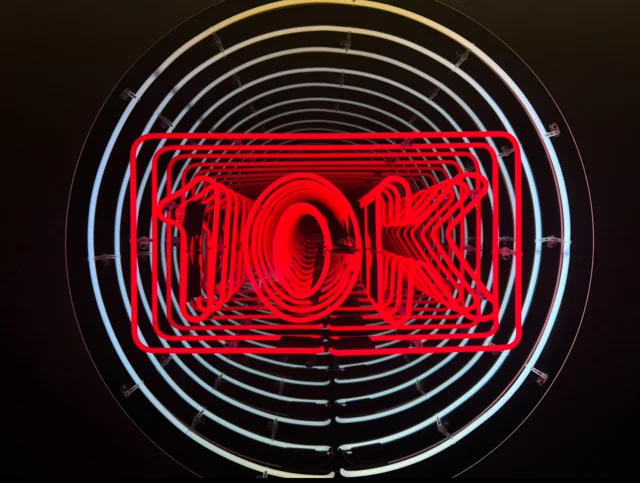
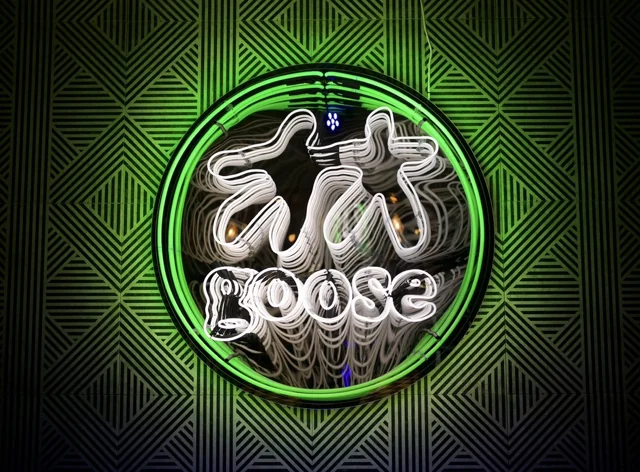
I've made a bunch of these signs for 10K Projects, Facile Beauty and Goose. They really have a magical effect. I love watching someone notice the first layer, then realize there's more going on and move closer to figure it out. The surprise isn't a separate decoration around your message. Your message is the thing doing it.
For experiential marketing events, product launches and pop-ups, that's an interesting way to give a familiar logo a different life. A mark someone has already seen on their phone becomes an object with apparent depth. It can sit behind a product counter, become part of an entrance or hold its own in a photo area. I wouldn't promise that any sign makes an event go viral, but I do think a thoughtful physical object gives people something more memorable to spend time with.
If you want people to read your message infinity times… put it on an infinity mirror. Hahaha. But seriously: short phrases and recognizable marks can work beautifully here. I want the first layer to read clearly before the reflections take over. It's still a sign, even when it feels like a little portal.
Custom infinity mirror logo signs: not just a ring of LEDs
The simplest infinity mirror repeats a lit border. A custom infinity-mirror logo sign can do a lot more: lettering, a drawing, a symbol, a frame, or a combination of those elements can become the repeated image. The 10K Projects and Goose pieces show two different ways to put an actual brand inside the effect rather than placing a logo on top of a generic mirror.
We can explore round housings, rectangular frames or a shape that responds to your artwork. The frame has a real thickness and visible edges, so its finish matters too. I look at the face, the side view and the surrounding materials together. A sign for a beauty counter doesn't necessarily want the same proportions or finish as a music-brand installation.
Color can come from the lettering, the border or both. A restrained combination can keep your logo readable; a more colorful direction can make the piece feel less expected. If you want color-changing LEDs, dimming or a programmed sequence, tell me early so the lighting and controls can be designed around that request. Not every light source supports every kind of control.
Scale and lettering need some judgment. Tiny details, very long sentences and closely packed lines can get busy when they're repeated. I'll help simplify where needed without losing what makes the mark yours. We also consider where someone stands: a close-up product display and a sign seen across a booth have different jobs.
Infinity mirror neon signs or LED infinity mirrors?
Both can create the effect. The mirrors do the repeating; the lighting gives them something to repeat. Real glass neon brings the physical character of hand-bent tubing into those reflections. LED neon or other suitable LED lighting can be a useful direction when weight, travel or lighting controls matter. I don't treat them as interchangeable materials.
For a glass build, I design around the tube bends, supports and electrical connections, as well as the space the mirrors need. For LED, I consider the profile of the light, how it follows the artwork and where its wiring and power supply go. The right choice depends on your logo, the intended look and what happens to the piece after it leaves my studio.
Infinity mirror letters, logos and short messages
If you're looking for infinity mirror letters, there are two different ideas worth separating. You might mean individual letter-shaped objects, each with a mirrored face, or lettering inside one larger mirror frame. My completed 10K Projects and Goose signs show the second direction: the artwork lives inside a shared reflective space, so the whole composition repeats together.
For a custom logo, that shared space lets me think about the relationship between the wordmark, any illustration and the lit border. For a campaign phrase, I look at line breaks, spacing and where the first readable copy sits. A message shouldn't become impossible to read just because we've found a fun way to repeat it. Send me the exact wording before we settle on the shape.
Infinity mirror displays for pop-ups and trade show booths
A custom infinity mirror display can be the detail that makes a temporary space feel considered. At a product launch, I might design the illuminated logo to sit behind the product rather than compete with it. In a trade show booth, I want to know which direction visitors approach from, how close they can get and whether there's a counter between them and the sign. A beautiful effect tucked behind a pile of merchandise won't do much for you.
A photo moment needs a slightly different conversation. Where does the person stand? Can you still see the mark around them? What else reflects in the face? The apparent depth is interesting on its own, but the real room and the camera angle still matter. I'll design with your art director or production team around those details instead of treating the sign as a last-minute prop.
A wall-mounted infinity mirror sign for your store or studio
The piece doesn't have to disappear when the event closes. A branded infinity mirror can move into a reception area, music studio, showroom or retail interior afterward. If that's the plan, tell me before we build it. A temporary booth wall and a permanent lobby wall may need different mounting, cable routing and access to the power equipment.
For a retail display, I think about how the sign feels when the lighting is off as well as on. You'll still see the frame and reflective face. The housing finish, nearby materials and regular cleaning all matter when people see it every day. I want it to belong in the space, not look like the event's leftover equipment.
Commissioning a custom infinity mirror vs buying a ready-made one
A ready-made LED infinity mirror can be perfectly good if what you want is a decorative tunnel of light. Commissioning a sign is a different brief: your logo or phrase has to become the illuminated object, with the right scale, frame, mounting and power arrangement for its location. That's the part I design with you.
If you've seen something called an endless mirror or an infinite mirror, you may be looking at the same basic reflection effect. What matters for your project isn't which name the listing uses. It's whether the piece can carry your artwork clearly, work in your lighting conditions and be installed where you actually need it. Send me the reference and we'll talk through what you like about it.
How I build a custom infinity-mirror sign
I start with the artwork and the place it's going. Your logo, rough dimensions, references and deadline give me something to design around. Then I work through the actual layers: rear mirror, lighting, front reflective face and housing. The mirror gap, the depth of the lettering and the front opening all affect how the finished piece reads.
The frame isn't just a box to hide the illusion in. It holds the reflective surfaces in position, supports the illuminated artwork and provides a route for wiring. Material choice needs to account for weight, handling and surface quality. Glass and mirrored acrylic have different advantages and compromises; I select the construction around the job rather than assuming one is always better.
For glass neon, the tubing is heated and bent to the design, then processed, gas-filled and connected to the appropriate transformer. For an LED build, the lighting is shaped or arranged to suit the artwork and connected to its specified driver. Neither version needs multiple physical copies of the logo. The mirrors make the copies for us.
Once the lighting and reflective layers are assembled, I check alignment, brightness, readability and the way the reflections behave from the intended viewing positions. Wiring, access to power components and heat management have to work alongside the visual effect. I want the piece to look good in the room and remain practical to install and maintain.
Mounting: plan for the whole object, not just the face
An infinity mirror is a framed assembly with depth and weight. Before choosing hardware, I need to know whether it's going on a permanent wall, an exhibit structure, a freestanding display or into a custom set piece. Send a photo or drawing of the mounting surface, and tell me what it's made of. A temporary scenic wall may need reinforcement before it can hold the sign safely.
Wall-mounted and freestanding arrangements can be explored around the build. Overhead suspension needs a separate conversation about weight, rated attachment points and who is responsible for rigging. Your venue or production team must approve its installation requirements; a photo of a suspended sign is not permission to hang one the same way at another venue.
I also think about the viewer's height, nearby lights and reflections from the room. An infinity mirror can reflect its surroundings as well as the artwork inside it. A strong light pointed directly at the face can compete with the tunnel effect. Getting the location right is often more useful than simply making the sign brighter.
Power, cables and everyday use
You power the physical lighting, not an endless stack of signs. The reflections themselves don't need additional electrical circuits. Actual power draw depends on the lighting type, total lit length, colors, controls and power equipment. I can work out the requirements for your approved build; there's no honest single wattage that covers every infinity-mirror sign.
Tell me where the outlet is, which supply voltage is available and whether cables need to disappear into a wall or display. LED lighting needs its specified driver, while glass neon needs the correct transformer and protected connections. Any mains wiring or high-voltage neon connections should be handled by a qualified professional, following the applicable installation requirements.
The housing needs appropriate heat management and access to the power components. Don't bury a driver in a sealed scenic compartment or change the wiring on site to make it fit. For a traveling activation, we should plan cable access, packing and repeat installation from the beginning. Outdoor use is a separate design brief, not something to assume from an indoor build.
What to send me, and when
Send your logo or phrase, approximate size, a few visual references and a photo or plan of the space. Include the event date, mounting surface, available power and whether the sign needs to travel. If an art director, exhibit builder or installer is involved, bring them into the conversation early. You don't need to arrive knowing how the mirrors should be built. That's my part.
I build in Glassell Park, Los Angeles, and can plan nationwide shipping around the finished piece. Typical turnaround is 2–4 weeks after artwork approval. Rush builds in under 24 hours can be possible for genuine emergencies, but a layered custom mirror build needs its own feasibility check. Tell me the real deadline and I'll be straight about what's possible, including after-hours or weekend work when needed.
Infinity-mirror signs are quoted around the specific build: artwork, size, materials, housing, lighting, mounting and delivery. The mirror assembly adds work beyond a standalone lit sign, so I'd rather give you a considered quote than apply a generic neon price to something different. If the piece will live in your office or store after the activation, let's design for that second home too.
Infinity-mirror sign FAQs
What is the difference between an infinity mirror sign and a regular neon sign?
A regular neon sign shows the physical illuminated artwork directly. An infinity mirror sign places lighting between reflective surfaces so that the artwork appears to repeat into depth. The mirror face, housing and viewing conditions become part of the design as well as the lettering.
Can an LED infinity mirror sign change colors?
It can if we specify compatible color-changing lighting and controls. That needs to be part of the design brief; a single-color build cannot simply be switched to RGB later. Tell me whether you want a fixed brand color, dimming or a programmed lighting sequence.
How much does a custom infinity mirror logo sign cost?
I quote the approved design rather than use a flat price for every mirror. Artwork, dimensions, lighting, mirrored surfaces, housing, mounting and delivery all affect the build. Send your logo, rough size, location and deadline for a project-specific quote.
Can you put my logo or a phrase inside an infinity mirror?
Yes. I design custom infinity-mirror logo signs and lettering rather than only illuminated borders. Send the artwork and rough size so I can check which details will read clearly as they repeat.
Is the tunnel actually deep?
The frame has real physical depth, but the much deeper tunnel you see is an optical illusion. Repeated reflections between the rear mirror and partially reflective front create the apparent depth, fading as they recede.
Does an infinity mirror use glass neon or LED?
It can use either. The reflective surfaces create the effect. I choose the lighting and construction with you based on the artwork, look, weight, handling and any requested controls.
How much electricity does an infinity-mirror sign use?
That depends on the actual light source and power equipment. The reflected copies don't add electrical load. Power requirements are worked out for your specific design, rather than estimated from how many reflections you can see.
Can it be wall-mounted or hung in a trade show booth?
Mounting is designed around the sign's weight and the supporting structure. A wall or booth may need reinforcement. Overhead installations require suitable rated attachments and approval from your venue and rigging team.
Will it work in a brightly lit room?
It can, but ambient light, glare and the viewing angle affect the result. Send photos of the space. I'll consider placement and lighting so the reflections have a chance to read instead of competing with a bright source pointed at the face.
Can it go outdoors?
Don't assume an indoor infinity-mirror sign is weatherproof. Outdoor use needs to be specified before design so materials, electrical protection and mounting can be assessed for the actual location.
Can you make one for an activation outside Los Angeles?
Yes, I build in Los Angeles and can plan nationwide shipping. Tell me the destination, event date and installer details so packing and installation can be considered with the design.
Part of a bigger build?
For show-floor layouts and exhibitor planning, see trade show booth signs. You can also explore brand activation signage or browse more completed projects.