Neon Signs in Los Angeles: An Insider's Guide from a Glass Fabricator
TL;DR: The best neon signs in Los Angeles are concentrated in Hollywood, the Fairfax District, Downtown's Broadway Theatre District, Chinatown, and the Valley - with a strong thread running through the Eastside where I work. As someone who bends glass tube for a living, I'll tell you what to look for and why these signs matter beyond the Instagram shot.
Why Los Angeles and neon go together
Los Angeles didn't just adopt neon - it introduced it to the country. In 1923, a Packard car dealer named Earle C. Anthony imported two neon signs from France and installed them at his dealership on Wilshire Boulevard. People reportedly stopped their cars in the street to stare. That's how powerful the medium was. That's how it started here.
By the 1930s, neon had spread across the city's commercial corridors - Hollywood Boulevard, Wilshire, Broadway downtown - and LA became the template for how American cities used electric signage to define themselves at night. The Broadway Theatre District, now recognized as the first and largest historic theater district on the National Register of Historic Places, became a concentrated showcase of neon blade signs, marquees, and rooftop pylons that still partly survive today. In 1996, a major preservation effort restored 25 neon signs along Wilshire Boulevard, bringing back a corridor that had gone dark over the decades.
I grew up in this city. I've been looking at its signs my whole life, and I've been bending glass tube professionally for years. When I tell you LA has a neon culture unlike anywhere else in the country, I'm not being promotional - I'm being accurate. The climate, the car culture, the entertainment industry, the density of mid-century commercial architecture: all of it conspired to make neon the city's visual language. It still is, if you know where to look.
The best neon signs in Los Angeles
Here's where to go. I've organized this by neighborhood cluster, because the best way to see neon signs in LA is to pick a zone and walk it after dark.
Hollywood & the Sunset Strip
The Frolic Room (6245 Hollywood Blvd, Hollywood, CA 90028) is the one I always send people to first. The multicolor neon sign dates to 1958 and it's still running - warm, slightly buzzy, exactly what neon is supposed to look like. What makes it technically impressive is the tight radius on the letterforms: whoever bent that sign knew what they were doing with a ribbon burner. It's a small sign, but the tube diameter is consistent throughout, which tells you it was made by someone with real control over the heat. The bar itself is a Hollywood dive next door to the Pantages Theatre, and the sign has outlasted most of what surrounded it.
The Brown Derby at 1628 N Vine St (Hollywood and Vine) is a different kind of story, and it belongs on any serious list of LA neon. The restaurant opened on Valentine's Day, 1929, became the celebrity hangout of the studio era, and was eventually demolished after the 1994 Northridge earthquake. But the famous rooftop hat sign - one of the most recognized neon signs in LA history - was rescued and restored by the Museum of Neon Art. You can see it at MONA in Glendale now. It's worth the trip specifically to study how a sign from that era was constructed: the hat form required compound curves that are genuinely difficult to execute in glass.
Up on the Strip, the Chateau Marmont sign at 8221 Sunset Blvd deserves more credit than it usually gets in these roundups. It's understated compared to a theater blade or a giant roadside figure - a simple, traditional-lettered parking sign against a hillside of palms - but that restraint is exactly the point. The hotel opened in 1929, and the sign has become as much a symbol of the building as the Châteauesque architecture itself. It's proof that a great neon sign doesn't need scale or spectacle. It just needs to be the right sign, in the right place, glowing quietly for a hundred years while everything around it changes.
Fairfax District
Canter's Deli (419 N Fairfax Ave, Los Angeles, CA 90036) has one of the best Art Deco neon signs still active in the city, and it's not close. The sign reads "Open All Night, Canter's Restaurant Bakery Delicatessen" in glowing green and yellow - two separate gas fills, two distinct color temperatures, mounted on a facade that hasn't changed much since the deli moved to Fairfax in 1953. What I notice every time I drive past it: the green and yellow hold their saturation well, which suggests the phosphor coatings inside those tubes have been maintained or the tubes have been re-gassed at some point. A neglected tube goes muddy. This one doesn't. If you want to see what a well-cared-for vintage sign looks like decades in, this is the reference point.
Downtown LA / Broadway Theatre District
If you want to understand what neon meant to Los Angeles at its peak, walk South Broadway after dark. The concentration of surviving theater signage here is unmatched anywhere in the city.
The Orpheum Theatre (842 S Broadway, Los Angeles, CA 90014) has both a 1930s neon blade sign and a 1941 marquee - two different eras of neon technology on the same building. The blade sign is the one I find most interesting from a fabrication standpoint: it's a large vertical format that required careful electrode placement to keep the gas pressure even across the full length of the tube. When those go wrong, you get dark spots at the ends. This one has been maintained well.
The Rialto Theatre (812 S Broadway, Los Angeles, CA 90014) has one of the longest neon marquees on the entire Broadway corridor - an Art Deco display updated in the 1930s that stretches across the full facade. Length is the enemy of consistent neon: longer tube runs mean more resistance, more heat variation, more chances for the gas fill to behave unevenly. A marquee that long, still glowing evenly, is a real achievement in sign maintenance.
Clifton's Cafeteria (648 S Broadway, Los Angeles, CA 90014) has a more complicated story. The sign now hangs in the alley behind the building rather than on the facade, and it's not currently lit - but it's worth seeking out. Clifton's reportedly contained some of the oldest neon tubes in the world, sealed behind a wall during a renovation and discovered decades later. That kind of accidental preservation is part of what makes LA's neon history strange and wonderful.
Chinatown
No list of LA neon is complete without Chinatown's Central Plaza (943 N Broadway), and honestly it deserves to be talked about as its own destination rather than a stop on the way somewhere else. When New Chinatown opened in 1938 - built by and for the Chinese-American community after the original Chinatown was razed for Union Station - the plaza was wired for neon from the start, and it shows. This isn't one landmark sign; it's an entire environment. Walk through the East Gate at night and the narrow walkways are lit almost entirely by decades of hand-lettered neon: restaurant signage, gift shop marquees, bar signs, layered on top of each other in red and green and gold. Individually, a lot of these signs would never make a "best of" list. Together, as a streetscape, they're one of the most complete surviving neon environments in the city - closer to what entire commercial corridors used to feel like before most of that density got stripped out everywhere else. If you only have time for one neighborhood-scale neon experience in LA, make it this one.
The Valley
People underestimate the Valley for neon. They shouldn't - and the sign that proves it is the single best argument for old-school glass neon still doing its job in this city.
The Circus Liquor Clown (5600 Vineland Ave, North Hollywood, CA 91601) at the corner of Vineland and Burbank Boulevard has been a landmark since 1960, and if I had to pick one sign to represent everything neon can do at scale, it's this one. It's a giant neon clown - not subtle, not architectural, just a massive roadside figure designed to be seen from a moving car at speed. The scale of it is what gets me every time. Bending a figurative sign that large requires sectioning the image across multiple tube runs and splicing them together without visible breaks in the light. When it works, the figure reads as continuous. This one works, and it's still real glass, still doing exactly what it did in 1960.
The Safari Inn (1911 W Olive Ave, Burbank, CA 91506) opened in 1955 and its sign has been restored since - but it still reads as mid-century motel neon, which is its own distinct genre. The color palette (warm white, red, the particular orange that neon gas produces in a clear tube) is exactly what that era looked like. It's appeared in enough films and TV productions that it's become shorthand for "classic LA motel." The sign restoration was done carefully: the proportions are right, and the tube diameter matches the original aesthetic.
Echo Park & the Eastside
This is my neighborhood. My studio is at 2121 Aaron Street in Echo Park, which puts me in the middle of one of the city's most neon-dense residential and commercial corridors - even if a lot of those signs are small, old, and easy to miss if you're not looking.
The Eastside - Echo Park, Silver Lake, Highland Park, Los Feliz - has a different neon character than Hollywood or Downtown. These aren't theater marquees or car dealership pylons. They're neighborhood signs: liquor stores, diners, laundromats, the occasional bar. Smaller tube diameters, simpler color palettes, more hand-lettered forms. In Highland Park, the "Coldest Beer in Town" sign at 5900 N Figueroa St is exactly that kind of piece - a vintage sign above a liquor store that's been there long enough to become part of the neighborhood's visual identity.
I drive past signs like that every day. They're the reason I got into this work. Not the famous ones, but the anonymous ones - the signs that nobody wrote about, that just kept glowing because someone kept paying the electric bill.
Honorable mentions: the ones we lost
Not every great LA neon sign is still lit, and some of the most talked-about ones in this city are the ones that are gone, dimmed, or replaced. It's worth naming them, because a city's neon history isn't just what's still glowing - it's what used to be, too.
Good Luck Bar (formerly 1514 Hillhurst Ave, Los Feliz) had one of the most distinctive signs on the Eastside - a glowing gold arrow with Chinese-style lettering that marked the entrance to a windowless, red-lit lounge for 25 years. The bar was evicted in 2019 when the property was redeveloped, and the fight over what happened to the sign afterward turned into its own sad chapter in LA neon history. It's still missed.
Cole's French Dip (Pacific Electric Building, Downtown LA) closed for good in 2025 after 117 years, and its neon sign over 6th Street had become as recognizable as the sandwiches inside. Cole's had survived Prohibition, the Depression, and nearly every economic downturn the city ever threw at it. What it couldn't survive was rent. The sign is still there, unlit, waiting to see if there's a next chapter.
The liquor store sign that's now Sipsy is the one that stings the most for a lot of neon people. A vintage neighborhood liquor store front, the kind of sign that used to be everywhere on the Eastside, converted into a slick modern alcohol-delivery storefront. It's clean, it's successful, and it's a real loss of character - a case study in how "revitalization" can also mean erasure.
The Brown Derby hat sign belongs here too, even though it technically survives - because surviving in a museum case isn't the same as glowing over Hollywood and Vine the way it did for decades. It's a rescue story and a loss story at the same time.
And Felix the Cat at Felix Chevrolet (3330 S Figueroa St) is the clearest cautionary tale in the city. The sign was nearly landmarked in 2007, the dealership promised to preserve it, and in 2012 the neon tubes were ripped out and replaced with LED strips anyway. It still looks like Felix from a distance. Up close, and to anyone who remembers the real thing, it's a different sign entirely - the flat, cold uniformity of LED standing in for the warmth and slight imperfection that made the original worth protecting.
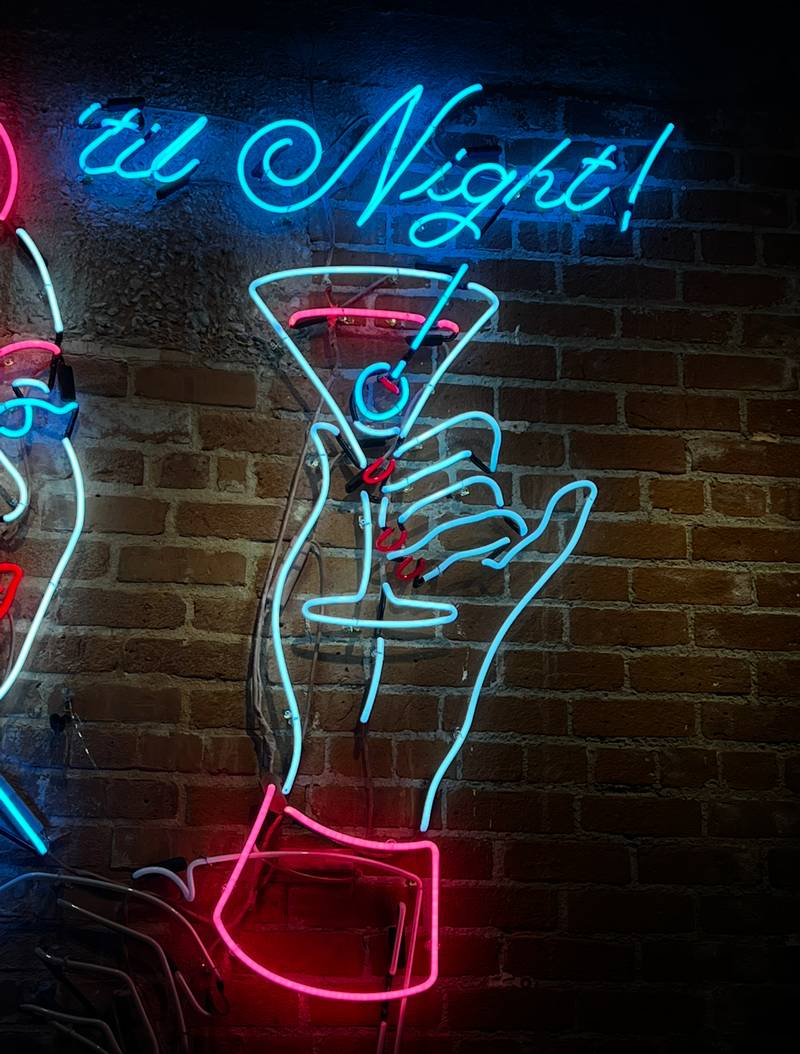
I'll add one of my own to this list, because it stung to lose. I built a 12'x12' neon piece for Citizens Public Market - a large-scale glowing lady figure with text that alternated between "from Day" and "til Night." It ran for four years in that space before it was taken down. It's a small loss compared to a century-old landmark, but it's the same story on a different scale: something that took real time to fabricate and glow, gone because a space changed hands or changed direction. That's the neon business as much as any of the famous names above - you build something meant to outlast you, and sometimes it doesn't even outlast the lease.
The Museum of Neon Art - the best place to understand LA neon
If you want context for everything above, go to MONA - the Museum of Neon Art, at 216 S Brand Blvd, Glendale, CA 91204. It was founded in 1981 by artists Lili Lakich and Richard Jenkins, originally in Downtown Los Angeles, and it holds the Guinness World Record as the first neon art museum in the world.
MONA does two things that matter. First, it preserves historic signs - including the Brown Derby hat - that would otherwise be lost. Second, it treats neon as a serious art medium, not just commercial nostalgia. The permanent collection and rotating exhibitions show you the full range of what the medium can do, from vintage roadside signage to contemporary neon sculpture.
The programs worth knowing about: Neon Cruises™ are nighttime double-decker bus tours that run through Downtown LA, Hollywood, Chinatown, and Koreatown, typically from around 7:00 PM to 10:30 PM on select evenings. Neon Night Walks are shorter walking tours through specific neighborhoods - Glendale, Koreatown, Echo Park, Hollywood, Downtown's Broadway Theatre District, and Chinatown among them. Both are led by people who know the signs and can tell you what you're looking at. Check neonmona.org for current schedules.
If you're serious about understanding the famous neon signs of Los Angeles, MONA is where that education happens.
What Los Angeles could learn from Seattle
It's a strange thing to say about the city that introduced neon to America, but Los Angeles could stand to learn something from Seattle about taking care of what it has. Seattle isn't thought of as a neon town the way LA or Las Vegas are, but its preservation instincts put ours to shame. At Pike Place Market, the Public Market Center sign was meticulously restored in 2022, and the market's preservation authority still maintains signs like the Loback Meat Co. sign decades after the business itself closed - because the sign is understood to have value independent of the business behind it. The Elephant Car Wash sign went through a formal landmark designation process. The old Seattle Post-Intelligencer globe is a protected city landmark too, even sitting unlit and waiting for funding to fix it properly rather than being gutted for LED out of convenience.
That's the difference. Seattle treats a historic sign as civic infrastructure worth the expense of real glass and real repair. Los Angeles - the city that made neon a national obsession in the first place - too often treats it as disposable the moment a developer or a franchise decides LED is cheaper. We invented this. We should be better at keeping it.
What makes a great neon sign - a fabricator's eye
People ask me what I look for when I see a vintage sign. Here's the honest answer.
Tube diameter consistency. A well-made sign uses the same diameter tubing throughout a given section, or transitions deliberately between diameters for visual effect. When you see a sign where the tube looks pinched or swollen in places, that's a heat control problem from the original bending - the glass was overworked. Consistent diameter means the gas pressure is even, the light is even, and the sign will last longer.
Color saturation. Neon gas in a clear tube glows red-orange. Argon gas in a clear tube glows blue-violet. Every other color - the warm whites, the greens, the pinks - comes from phosphor coatings baked inside the tube. Those coatings degrade over time, especially under heavy use. A sign with rich, saturated color has either been re-gassed or maintained well. A sign that looks washed out or muddy is showing its age in the phosphor layer, not the glass.
Bending quality on curves and letterforms.This is the one that separates fabricators. Tight curves - the inside of a letter "e," the loop of a script "g" - require precise heat application and fast, controlled movement. Too slow and the glass collapses. Too fast and you get a kink. A clean bend looks effortless. You can see the difference in a sign from 20 feet away: smooth curves read as continuous light, bad bends create bright spots and shadows.
Electrode condition. The electrodes are the metal end caps where the electrical connection is made and the glass tube is sealed. On an older sign, look at the ends of each tube section: if the glass around the electrode is discolored or dark, the seal is failing or the transformer is running too hot. A sign with clean, clear glass at the electrodes is a sign that's been properly maintained - or was built right to begin with.
These are the things I notice before I notice anything else. They're also the things I think about every time I start a new piece.
FAQ
Where can I see neon signs in Los Angeles?
The best neighborhoods for neon signs in LA are Hollywood and the Sunset Strip, the Fairfax District (Fairfax Avenue and La Brea), Downtown's Broadway Theatre District (South Broadway between 3rd and 9th), Chinatown's Central Plaza, and the Valley (North Hollywood and Burbank). The Eastside - Echo Park, Highland Park, Silver Lake - has a denser concentration of smaller, older neighborhood signs that reward slower exploration. For a guided experience, MONA's Neon Cruises and Neon Night Walks cover most of these areas with expert commentary.
Is there a neon sign museum in Los Angeles?
Yes. The Museum of Neon Art (MONA) is at 216 S Brand Blvd, Glendale, CA 91204 - technically Glendale, but within the greater LA area. It was founded in 1981 and holds the Guinness World Record as the world's first neon art museum. The collection includes historic signs rescued from around the city, contemporary neon art, and hands-on educational programs. Visit neonmona.org for hours and ticketing.
What is the most famous neon sign in LA?
That depends on who you ask, but the Frolic Roomsign on Hollywood Boulevard is probably the most cited among people who know neon - it's been running since 1958, it's in excellent condition, and it's in a location where millions of people walk past it. The Brown Derby hat sign is arguably more historically significant, but it's now at MONA rather than its original location. The Circus Liquor Clownin North Hollywood has a strong claim based on sheer scale and longevity, and the Chateau Marmont sign has a claim of its own simply for having glowed over the same hillside for nearly a century. There's no single answer, which is part of what makes the best neon signs in Los Angeles worth arguing about.
Can I get a custom neon sign made in Los Angeles?
Yes - and if you want real hand-bent glass neon rather than LED flex strip, you need to find a studio that still works in glass. Most of what's marketed as "neon" today is LED tubing shaped to look like neon, which is a different product with a different visual quality and a different lifespan. For custom neon signs Los Angeles fabricated in genuine glass, look for a studio with a working shop, a portfolio of completed pieces, and a fabricator who can walk you through the process - from design proof to gas fill to installation. Lead times for custom glass neon typically run two to eight weeks from first conversation to installed sign.
Useful sources
Museum of Neon Art (MONA) - the authoritative source for LA neon history, preservation, and tours, including Neon Cruises and Neon Night Walks schedules.
LA Conservancy - Canter's Deli - the Los Angeles Conservancy's historic places entry on Canter's, with architectural and signage context.
LA Conservancy - Museum of Neon Art (MONA) - the Conservancy's documentation of MONA as a historic place in its own right.
KCRW: When Los Angeles Was the Neon City - a radio documentary on the history of neon in LA, with archival material on the city's neon peak and decline.